


Product-led growth turns your product into the main engine of acquisition and makes content a core part of the user experience. In this article, I explore why PLG and SEO-driven content marketing complement each other, how they lower CAC, and why sales-led models often struggle to convert content effectively.
Article originally published in 2021, updated in 2025.
30-Seconds-Summary
- Product-led growth is a go-to-market strategy that eliminates demos and allows users to interact with the product immediately. In terms of marketing, the product itself becomes the primary driver of customer acquisition.
- In PLG companies, content not only extends the product but is also an integral part of it.
- PLG companies are characterized by shorter sales cycles and lower Customer Acquisition Costs (CAC).
- PLG creates an environment where content marketing can thrive.
- Content marketing can be effective in sales-led companies, but PLG and content marketing work best together.
- Canva is a prime example of a PLG company that embraces SEO-driven content marketing.
What are Product-Led Growth Companies?
I think it’s fair to say that the term “Product-Led Growth” was famously coined by Wes Bush. In his book “Product-Led Growth: How to Build a Product That Sells Itself”, he describes product-led growth (PLG) as “a go-to-market strategy that relies on using your product as the main vehicle to acquire, activate, and retain customers.”
I won’t delve into the details of the concept itself in this post, but I’ll do my best to explain its basics. This is important for me to get my point across.
Here we go:
In contrast to sales-led companies, PLG companies forgo the traditional approach of using lead magnets, demos, and sales teams that rely on interacting with prospects to sell the product.
PLG companies, in most cases, sell their product without any sales team involvement. They build their product in a way that makes it easier for the user to sign up, use the product, and solve their first problem within a very short amount of time.
PLG companies avoid demos. They empower users to onboard themselves by using a “Bowling-Alley Frameworkk”, which includes conversational and product bumpers.
Conversational Bumpers
- Onboarding Emails
- In-App Messages
- Customer Success Outreach
Product Bumpers
- Product Tours
- Progress Bars
- Onboarding Tooltips
Relying on PLG means empowering the user to see the product in action and generate a first “aha moment” quickly, without an introductory demo appointment (or a “real” sales team in many cases).
For example, if you’ve ever used Hotjar, you know how it feels to navigate within a PLG framework from a user’s perspective. It takes just a few minutes from
- signing up
- to creating your first heatmap (action) and
- seeing the first user interaction on your website (aha moment).
This is how the PLG approach typically reduces the prospect’s time-to-value and shortens the sales cycle. In a nutshell, PLG sees the product as the main driver of growth for the company (especially SaaS).
Over the last few years, there has been a shift away from a sales-led approach to a more product-centered approach. This shift is mainly based on the competitive advantages of the approach and the users’ demand to test and explore a product on their own.
What Does Any of This Have to Do With Content Marketing?
After I finished Wes’s book for the first time, I felt that one piece of the puzzle was missing. While reading, a hypothesis began to form in the back of my mind: “PLG companies are the perfect environment for successfully executing SEO-driven content marketing.”
So I started investigating whether my hypothesis could be true. To do this, I looked at some very successful PLG companies that came to mind. It became clear to me that these companies share a common trait: great SEO-driven content marketing.
All of these companies seem to be heavily investing in content, and they do this for a good reason.
In the next chapter, I will argue that SEO-optimized content marketing and a PLG approach are complementary, and how every PLG-based company can benefit from a solid SEO-driven content marketing strategy.
Content Marketing and Complementarity
SEO-driven content marketing is pull marketing. That is, you create content that ranks on search engines (or search engine-like platforms like Pinterest). It ranks because it answers users’ questions better than other content does (each search query represents a question that needs to be answered). You satisfy user demand and draw them into engaging with your content. So far, so good.

Content Marketing in Sales-Led Companies
Some companies struggle to implement a revenue-generating SEO-driven Content Marketing Strategy successfully.
Some reasons for this include:
- The company is unable to generate SEO traffic in the short and medium term
- There is SEO traffic, but it does not significantly contribute to the revenue goals
- The SEO traffic generates low-quality leads, creating internal stakeholder conflicts (i.e., with the sales team)
These issues often arise in companies
- that are not committed to investing in a marketing strategy that will yield results in the medium or long term, or
- where the teams are not aligned in terms of incentives. In such cases, the marketing team optimizes for lead quantity, while the sales team focuses on lead quality.
The low-lead quality issue is a symptom of an underlying structural problem. It’s a real “double whammy” because generating SEO traffic not only incurs costs but also ties up resources within the company and disrupts the often fragile sales process.
It’s not difficult to generate a lot of organic traffic around virtually any topic. The demo is the bottleneck. Sales-led companies are incentivized to prioritize high-quality leads to avoid overwhelming the sales team. This can lead to frustration on the marketing side, where goals may be driven by quantitative metrics.
If the sales team attempts to qualify low-quality leads using time and resources, significant opportunity costs can arise.
In content marketing, sales-led companies that require one sales activity to close the sale often face a major challenge: If the content isn’t “transactional” enough, it may serve little purpose or disrupt the entire process.
Optimizing for the demo means being selective about which leads to attract. In the worst-case scenario, generating low-quality leads through content can create friction in the sales process.
That’s why many sales-led companies must be cautious when executing an SEO-driven Content Marketing Strategy. SEO traffic can potentially generate leads that may clog up the system.
One solution is to qualify leads through forms with filters. Depending on the user’s responses, the lead can be either forwarded or processed through an automated CRM system.
Bottom line: Content Marketing and a sales-led approach can sometimes lead to inefficiencies – they operate under different logics and don’t always yield mutually reinforcing effects.
Content Marketing in Product-Led Companies
Why is this not an issue in PLG companies? The primary reason is that PLG companies do not face the same demo bottleneck. The sale can occur without the sales team needing to engage with the prospect. SEO-driven Content Marketing scales, whereas scaling the sales team at the same pace is challenging.
From this perspective, there is a complementary relationship between Customer Acquisition Costs (CAC) and the internal demand for content marketing in PLG companies, similar to complementary goods:
- The product-led approach will lower CAC
- Effective SEO-driven Content Marketing will further reduce CAC in the medium term
- Increased SEO traffic leads to more sign-ups and revenue without clogging the system
Of course, SEO-driven Content Marketing can also succeed in Sales-Led companies. However, the SEO team may be incentivized to create content that primarily attracts high-quality leads, limiting scaling opportunities. Alternatively, the sales team may need to develop an effective system for filtering out low-quality leads. This can create a frustrating dynamic, as both teams (content marketing and sales) may not always be aligned toward the same goal.
In PLG companies, content becomes part of the product. Often, it serves as the first touchpoint a user has with a brand or the product itself. The key difference in content for sales-led companies is that, in PLG companies, content does not necessarily have to qualify the lead.
This means that content marketing in PLG companies will never disrupt sales processes. A sales activity like a demo is not a prerequisite for making a sale, eliminating limiting factors.
This fundamentally alters the dynamics of content creation within a company. The worst-case scenario is that content marketing incurs higher opportunity costs than acceptable, as even PLG companies can produce content that is “useless.”
In such cases, the entire content strategy will be impacted. Teams can be more experimental and risk-taking because they do not have to worry about their content overwhelming the sales team. Additionally, in terms of the bowling alley framework, content can serve as a bumper during onboarding.
A strong help center enables customers to assist themselves. A great company will recognize how content creation enhances the product by attracting new users, educating both new and existing users, and delighting current customers.
In this way, content can significantly contribute throughout the entire customer journey:
- It attracts new users
- It positions the company as an expert in its niche, thus building trust (halo effect)
- It helps users solve their problems
- It aids users in understanding their “real” problems
- It broadens the top of the funnel by covering topic clusters related to the product
- It creates new marketing opportunities (i.e., retargeting)
- It increases overall brand visibility and can potentially generate PR opportunities
Content becomes the product. It not only expands the funnel but also assists users with problem-solving at every stage of their journey.
Example: Canva
Canva is an online design tool that allows you to:
- Create sophisticated designs online
- Collaborate and comment as a team in real-time
- Use thousands of free graphics
There’s a very inspirational “How I Built This” NPR Podcast episode featuring Canva’s founder, Melanie Perkins.
Although they experienced a slight decline in traffic, Canva achieved impressive organic growth through the /learn subdirectory, which represents their blog (but functions more like a learning hub).
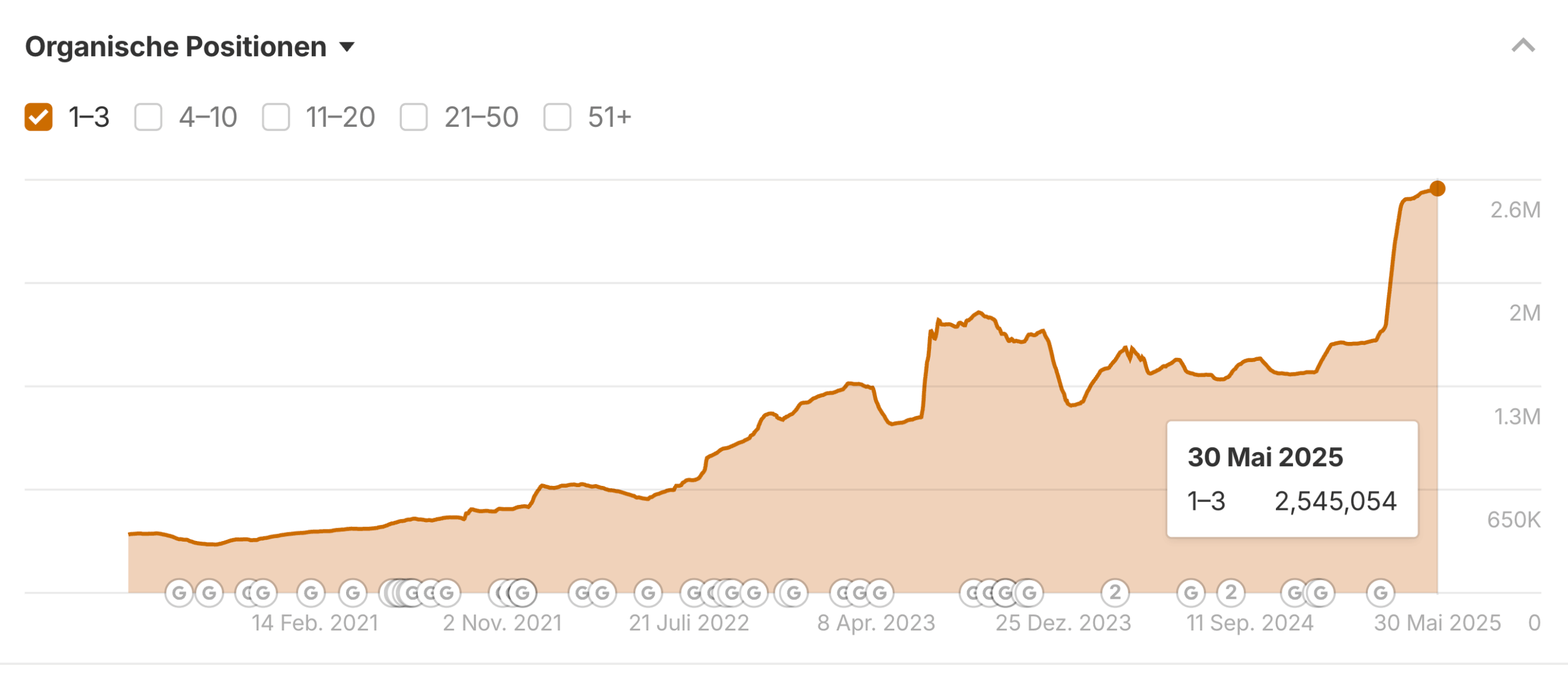
Similar to the example above, Canva ranks for topics that are directly connected to their product. If someone searches for “mood board,” in many cases, they want to create one.
Canva provides an article targeting those searches and seamlessly transitions to the product, which helps users create a mood board and addresses their “problem.”
Wrapping up
Content marketing is a powerful marketing approach. It becomes even more effective when there is alignment within the company towards creating great, revenue-generating content.
For that reason, product-led companies provide an ideal environment for content marketing to reach its full potential.
There are many examples that illustrate how content becomes more than just an extension of the product – it becomes the product.