


The SEO community has been through many cycles of change. When Google rolled out Hummingbird in 2013, many SEOs kept optimizing for exact-match keywords while others soon realized the game had shifted to semantic search. The marketers who understood entity relationships and topical authority early gained an advantage.
We’re in a similar window now, except new systems are emerging as a parallel world. This is a big difference: ChatGPT and Co. are not a variation of an existing search engine. They apply different logics but target the same users. It’s not about algorithm updates, it’s about a different retrieval paradigm competing for the same user behavior. And if these users switch to the new systems to get answers for “old” questions, it’s the marketer’s job to win these channels.
Of course, according to click data, Google is still dominating the search market. But most experts don’t seem to doubt that ChatGPT, Gemini, and Co. have massive potential to gain market share – fast. Some industry experts (from an AI search analytics platform) even believe  that “ChatGPT represents somewhere between 4% to 12% of Google’s search volume”.
In this article, I summarize the findings of four studies that examined what works in AI search. The newest one is from October 2025. The research consists of controlled experiments with thousands of queries, algorithmic analysis of citation patterns, and automated systems testing and optimization approaches. Different teams, different methods, converging findings.
What they reveal isn’t the complete picture of how these systems work. That’s probably impossible given how quickly they evolve. But they provide testable patterns that work across engines right now, and they challenge assumptions many marketers are operating under.
Throughout the article, I cite the four studies with page numbers so you can cross-check and explore further in the source.
Studies and Methodologies
When four different research teams use different methods (from running massive “science fair” competitions between engines to building “robot detectives” that reverse-engineer the algorithm), and they find the same things, marketers should probably pay attention.
Study 1
“Generative Engine Optimization: How to Dominate AI Search”
Chen et al., 2025
The researchers created ranking-style prompts across multiple verticals (consumer electronics, automotive, software, banking, etc.). Examples: “Top 10 smartphones in 2024” or “Best laptops for students.”
Each query was sent to Google and multiple AI engines simultaneously, collecting both the answers and all cited sources.
Every cited domain was categorized into three buckets:
- Brand: Official company sites (apple.com, toyota.com)
- Earned: Third-party reviews, news outlets, independent publishers (Forbes, TechRadar, Consumer Reports, NerdWallet)
- Social: Community platforms (Reddit, YouTube, Quora)
Using Jaccard similarity (basically a scientific Venn Diagram on steroids), researchers quantified how much agreement existed between different engines and conditions. They tested how results changed when queries were translated into other languages or rephrased differently.
Study 2
“What Generative Search Engines Like and How to Optimize Web Content Cooperatively”
Wu et al., 2025
This study didn’t just want to watch the AIs. The researchers wanted to build a machine that automatically learns how to win at the game. They called this system AutoGEO.
They looked at two websites that answered the same question. One website got picked by the AI (the Winner), and one didn’t (the Loser). They asked a smart AI, “Hey, look at these two. Why did the Winner win?”
The AI might say, “The winner won because it put the conclusion at the very top.” The scientists did this thousands of times and collected all these reasons into a big “Rule Book”.
They tested the new “makeover” websites to see if AI liked them better. They measured two things:
- Visibility: Did the AI pick the website more often?
- Utility: Did the AI actually give a better answer because of the rewrite?
Study 3
“GEO: Generative Engine Optimization”
Aggarwal et al., 2024
Think of this as the SATs for websites. The researchers wanted to see if specific “study habits” (optimization tactics) could help websites get better grades (higher rankings) from AI.
They created a massive benchmark of thousands of diverse queries. Everything from “benefits of a keto diet” to historical debates. They found the websites that were already ranking for these questions to use as their test subjects.
They took these websites and applied specific changes to them to see what would happen. For example:
- Statistics Addition: Adding numbers and data.
- Authoritative Tone: Rewriting text to sound more confident and expert.
- Cite Sources: Adding links to verify claims.
- Keyword Stuffing: Jamming in keywords.
The researchers fed both the original and the modified websites into generative engines (like Perplexity). They measured Visibility using a strict metric: did the website appear in the answer, and how close to the top was it?
Study 4
“Beyond SEO: A Transformer-Based Approach for Reinventing Web Content Optimisation”
Lüttgenau et al., 2025
This research team wanted to see if these tricks worked in the real world of travel booking, where details matter.
They scraped 1,905 real travel website texts to create a library of raw content. They didn’t just rewrite text manually; they trained AI to become a “Travel Content Expert.” They taught it to rewrite travel descriptions using proven GEO strategies like improving fluency and adding data.
They ran a simulation where they fed this new, optimized content into a powerful AI (Llama-3.3-70B) to see if it would “recommend” these travel packages more often than the original, raw text. They measured success by whether the optimized text won a bigger share of the citations in the final answer.
Generative Engine Optimization: How to Win AI Search According to Science
The value in these studies isn’t that they solve GEO completely. They replace speculation with testable observations. When different research teams using different methods find consistent patterns, those patterns are worth taking seriously. Even if we acknowledge constraints regarding the replicability in the real world, and the fact that they might shift as the technology evolves.
What follows are the patterns that appeared most stable across studies. Some confirm what good content practitioners already suspected. Others suggest the game works differently than most assume. All of them are worth testing in your context.
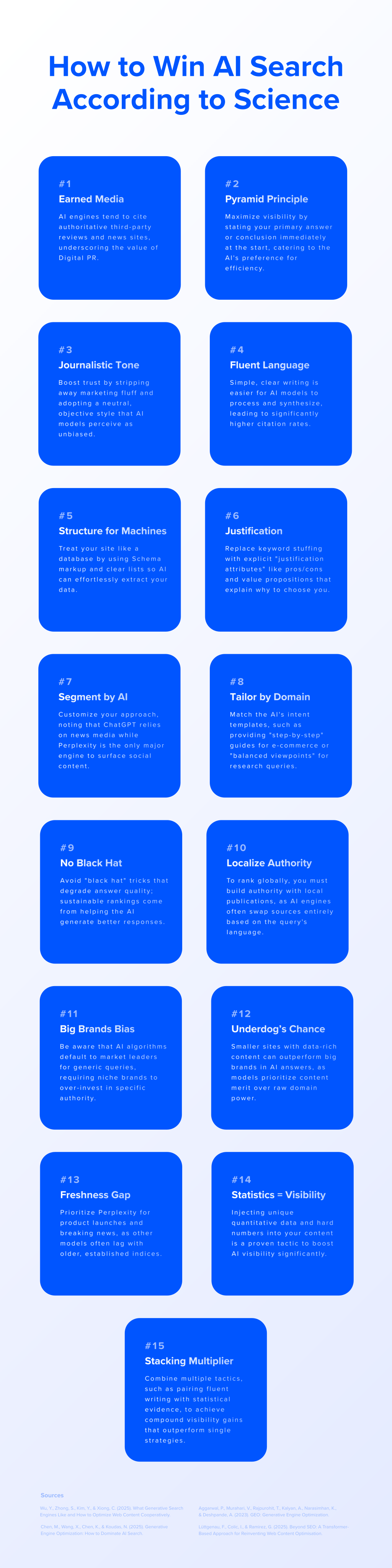
Earned Media Renaissance
AI search engines show a measurable preference for third-party sources over brand-owned content. In categories like Consumer Electronics, over 80% of AI citations come from earned media (reviews, news, independent publishers) compared to Google’s more balanced mix that includes brand websites and social content (Chen et al., 2025, p. 17).
If your visibility strategy focuses only on optimizing your own blog or corporate website, you might be missing out on AI search visibility. These engines appear to treat brand content as inherently less credible, a different trust model than traditional search. This doesn’t mean brand content is worthless (not at all), but it suggests the path to visibility also runs through others vouching for you, not you vouching for yourself.
Implication: Budget allocation may need to consider digital PR, expert collaborations, and securing coverage in authoritative publications. Success metrics should expand beyond traffic to your domain to include mentions in third-party “citation networks” like industry publications (Chen et al., 2025, p. 25). Building relationships with publishers and creating a pipeline for expert commentary in authoritative outlets becomes more valuable, as these are the sources AI engines consistently cite.
Pyramid Principle for the Win
Algorithmic analysis of “winning” documents reveals a distinct structural preference: the “Conclusion First” rule (Wu et al., 2025, p. 4). AI agents value documents that state the primary finding or answer immediately at the beginning (Wu et al., 2025, p. 16). A conclusion-first structure gets cited more often.
AI models process text linearly and prioritize efficiency. Introductions that “set the scene” or use narrative fluff delay the retrieval of the answer, causing the AI to rank the document lower or ignore it entirely.
Implication: Optimizing for AI search means adapting the content’s “above the fold” experience. If the user asks, “What is the best X?”, the first paragraph should explicitly state, “The best X is [Product] because…”. Avoid rhetorical questions or long-winded backstories in the introduction.
Journalistic Tone
Generative engines tend to penalize promotional language. Extracted preference rules emphasize a “Neutral Tone” that avoids personal opinions, bias, and sales-heavy adjectives (Wu et al., 2025, p. 15).
AI models are trained to detect and filter out “noise.” They interpret marketing copy (e.g., “groundbreaking,” “industry-leading”) as low-information density or potential bias, preferring an “unbiased and journalistic tone” (Wu et al., 2025, p. 15; Chen et al., 2025, p. 3).
Implication: Audit your content for adjectives and adverbs. Replace subjective claims with verifiable facts (e.g., change “fastest charging” to “charges 0 to 100% in 15 minutes”) (Wu et al., 2025, p. 15). Adopt an encyclopedic style rather than a persuasive copywriting style. This doesn’t mean your content should be dry or boring. But the path to citation appears to run through objectivity, not enthusiasm.
Fluent Language Outperforms Prose
A common myth in SEO was that long, complex content kept users on the page and signaled depth. AI engines, however, prefer content they can easily process and synthesize.
Strategies labeled “Fluency Optimization” and “Easy-to-Understand” yielded visibility gains of 15 to 30% in the GEO-Bench study (Aggarwal et al., 2024, p. 6). The travel study achieved similar gains by simplifying phrasing and improving linguistic flow (Lüttgenau et al., 2025, p. 8).
Implication: Cut the jargon. Use simple sentence structures. If an AI can parse your content faster, it appears more likely to use it. Complexity for its own sake may be working against you.
Structure for Machines (“API-able”)
AI agents are moving from simple retrieval to performing tasks. To do this, they view websites as databases. They require “Logical Structure” with clear headings, lists, and distinct paragraphs to parse information accurately (Chen et al., 2025, p. 5; Wu et al., 2025, p. 15).
If an AI cannot easily extract a price, warranty term, or spec because it is buried in a paragraph, it will hallucinate or skip your product. Unstructured data makes you “hard to do business with” for an AI agent [Chen et al., 2025: 5].
Implication: Treat your website as an API. Implement Schema.org markup for all entities (products, reviews, prices). Use HTML tables for comparisons and bullet points for features, ensuring the content is machine-scannable (Aggarwal et al., 2024, p. 6; Wu et al., 2025, p. 15).
Justification is the New Keyword
Optimization has shifted from keyword matching to “Justification.” AI engines build answers by synthesizing a shortlist and justifying their choices (Chen et al., 2025, pp. 4-5). They prioritize content that explicitly contains “justification attributes” (pros/cons, unique features) (Chen et al., 2025, p. 5). Of course, we know this principle from SEO and the whole discussion around YMYL and EAAT.
It is not enough to be relevant to the topic; you must provide the argument the AI uses to recommend you. The brand that makes it easiest for the AI to extract reasons to buy wins the recommendation.
Implication: Engineer your content for synthesis. Exercise the reflection on the topic publicly. Create specific “Pros and Cons” lists. Use bold text to highlight value propositions (e.g., “Best for small kitchens”) so the AI can easily extract the “why” (Chen et al., 2025, p. 5).
Segment by Engine Personality
“AI Search” is a fragmented market with distinct engine behaviors, as described in this article about AI citations.
- ChatGPT and Claude: Conservative, rely on “Earned” media (publishers/wikis), and often ignore Social media (Chen et al., 2025, p. 1, 7, 8).
- Perplexity: The “wild card” that surfaces Social content (YouTube, Reddit) and Retail sites (Amazon, Best Buy) (Chen et al., 2025, p. 1, 8, 17).
- Gemini: More balanced, showing a higher propensity to cite official “Brand” websites than the others (Chen et al., 2025, p. 8, 22).
A single SEO strategy will fail to capture the entire market. A strategy that wins on Perplexity might result in zero visibility on Claude. Marketers have to make up their mind on which LLM they want to place their bet. When I optimize content for LLMs today, will my target group see it? Which LLM will have the most users I want to reach?
Implication: You need to choose which engines matter most for your audience. For ChatGPT and Claude, focus on high-tier digital PR and Wikipedia visibility (Chen et al., 2025, p. 26). For Perplexity, invest in YouTube content and optimization on major retail partners (Chen et al., 2025, p. 26). For Gemini, strengthen technical SEO and content depth on your own domain (Chen et al., 2025, p. 26).
Tailor by Domain
Preference rules change based on the user’s intent and vertical.
- E-Commerce: The AI prioritizes “Actionable” content, “Step-by-Step” guides, and clear recommendations (Wu et al., 2025: p. 9, 15).
- Research/Info: The AI prioritizes “In-Depth” content that explains mechanisms (“how” and “why”) rather than just stating facts (Wu et al., 2025, p. 9).
Providing “comprehensive” content looks different for a shopper vs. a researcher. Failing to match the specific “rule set” for your vertical reduces visibility (Wu et al., 2025, p. 9).
Implication: E-commerce should focus on “How-to” guides, production details, and actionable advice, while publishers and B2B brands should focus on explaining underlying causes, context, and providing a “Balanced View” (Wu et al., 2025, p. 9, 15).
Cooperation Beats Manipulation
Adversarial tactics, aka black hat tactics (e.g., injecting hidden text to trick the AI), can shortly increase visibility but consistently degrade the Utility, making the answer less faithful or lower quality (Wu et al., 2025, p. 8).
Engines are incentivized to patch these exploits to protect their utility. “Cooperative” optimization (improving structure, citation accuracy, and clarity) improves both visibility and the AI’s performance, making it a sustainable long-term strategy (Wu et al., 2025, p. 8).
Implication: Avoid “black hat” GEO tactics like hidden keywords (keyword stuffing). Make sure your content is helpful and accurately supports the key points the user is searching for (Wu et al., 2025, p. 5).
Localize Authority, Not Just Language
AI engines handle multilingual queries differently.
- Perplexity/ChatGPT: They “localize,” swapping its source list to local-language publishers (e.g., citing German sites for German queries). Although in an analysis with a sample of 600 citations, I found that ChatGPT used English sources in 50% of the cases (German YMYL queries).
- Claude: Shows high “cross-language stability,” often reusing authoritative English sources even for non-English queries.
Simply translating your English website is insufficient for GPT or Perplexity because they look for local authority, not just local language.
Implication: For GPT/Perplexity markets, you could run Digital PR campaigns to earn coverage in local-language publications (Chen et al., 2025, p. 26). For Claude, a strong English-language authority profile can carry over to other regions.
Big Brands Have a Head Start
For unbranded queries (e.g., “best soda,” “top CRM”), AI engines exhibit a “Big Brand Bias,” defaulting to market leaders (e.g., Coke, Salesforce) (Chen et al., 2025, p. 19).
Niche or challenger brands are structurally disadvantaged. The AI uses “source prominence” as a proxy for relevance, effectively ignoring smaller players unless they have significant verified authority (Chen et al., 2025, p. 20).
Implication: Niche brands cannot rely on general queries. They need to “over-invest” in verified authority, getting more citations and expert validation than a big brand to get the same visibility (Chen et al., 2025, p. 27). Target specific niches where you can dominate a narrow topic and build “tangible, verifiable authority” rather than competing on broad terms (Chen et al., 2025: 27).
Underdogs have a Chance
Here’s where the news gets interesting for smaller players. GEO appears to offer opportunities for sites with strong content but weak traditional SEO metrics.
The research shows that lower-ranked websites (e.g., those ranked #5 on Google) saw visibility boosts of up to 115% after applying GEO tactics. Meanwhile, top-ranked sites sometimes saw decreases as the AI leveled the playing field (Aggarwal et al., 2024, p. 8).
Implication: If you have quality content but struggle with domain authority or backlink gaps, AI search may reward you more fairly than traditional search. The systems appear to weight content merit and structure more heavily than raw backlink volume. This creates windows for leapfrogging incumbents in generative answers even if you’re not on the first page of Google. This advantage matters most for informational queries, not necessarily for broad commercial terms where brand recognition still dominates.
The “Freshness” Gap
If your business depends on breaking news or recent events, engine choice matters critically. The data shows that Claude and GPT rely on older, established content (mean article age: 117 days for Electronics), effectively ignoring recent posts.
Perplexity, however, is much fresher, indexing newer content and commercial data faster. If you need visibility for a product launch this week, Perplexity is your primary target; the others may not even see you yet (Chen et al., 2025, pp. 21-22).
Implication: Prioritize Perplexity for timely content. Ensure your product is discoverable there through strategies like video optimization (since Perplexity integrates YouTube) or listing on major retail sites it indexes.
Statistics Drives Visibility
Subjective claims are often ignored by generative engines, while hard data is cited. The inclusion of quantitative evidence is emerging as one of the single most effective on-page tactics for boosting visibility.
The GEO-Bench study found that adding unique statistical evidence improved visibility by 37% (Aggarwal et al., 2024, p. 6). This was confirmed in the travel domain study, where a model fine-tuned to inject statistical data into website descriptions contributed to a 31% boost in visibility (Lüttgenau et al., 2025, p. 8).
Implication: Don’t just say your product is “popular.” Say it “served 10,000 customers in 2024.” AI models treat data density as a proxy for information quality.
The “Stacking” Multiplier
Don’t just pick one strategy. The research found that combining GEO tactics creates a multiplier effect. The most powerful combination found in testing was Fluency Optimization + Statistics Addition.
This pairing outperformed any single strategy by over 5.5%, proving that style (fluency) and substance (stats) work best together (Aggarwal et al., 2024, p. 8).
SEO vs. GEO: Paradigm Shift or Old Wine in New Bottles?
Is AEO/GEO/LLMO just SEO with nuances? A good way to think about this: A best-practice-driven SEO strategy will get you very far in AI visibility. For most companies that are already doing SEO, the main implication is to include GEO as a new variable in the search mix (as Rand Fishkin pointed out, it’s Search Everywhere Optimization )
This might result in new budget and time allocation, for example shifting more resources to PR. It can also mean enriching new content with additional data or refreshing existing content with actionable elements, if helpful to users.
-
Helpful Content
Cooperative optimization improves both visibility and AI performance. Content must accurately support what users are searching for.
-
Authority (E-E-A-T)
AI engines treat brand content as less credible. Niche brands need more citations and expert validation than big brands for equal visibility.
-
User Intent Matching
E-commerce queries need actionable, step-by-step content. Research queries need depth explaining “how” and “why.”
-
Earned Media/Mentions
In Consumer Electronics, over 90% of AI citations come from third-party reviews and publishers, not brand websites.
-
Conclusion First
AI models process text linearly. State your answer in the first paragraph. Introductions with narrative fluff get ranked lower or ignored.
-
Clarity & Readability
Replace subjective claims with verifiable facts. Change “fastest charging” to “charges 0-100% in 15 minutes.”
-
Fluent Language
Fluency optimization yielded 15-30% visibility gains. Cut jargon, use simple sentences. If AI parses faster, it cites more.
-
Technical Structure
Treat your website as an API. Use Schema.org markup, HTML tables, and bullet points so AI can extract data without hallucinating.
-
Black Hat = Bad
Adversarial tactics like hidden text may boost visibility short-term but consistently degrade answer quality. Engines patch these exploits.
The research provides a useful lens for analyzing existing and future content. As LLMs and AI chatbots are evolving and gaining market share within the world of search, it makes sense for marketers to know how to win visibility.
While both disciplines share the goal of visibility, the mechanics of how that visibility is achieved (and who is rewarded) are somewhat different. Based on the four studies, here is where the two worlds diverge.
Ranking vs. Synthesis
In traditional SEO, you compete for a ranking position (e.g., “Rank #1”). In GEO, you compete for synthesis. The goal isn’t just to be listed; it is to have your content extracted, processed, and woven into a direct answer.
Success is measured by “Position-Adjusted Word Count”. How much of your text is the AI using to speak to the user? (Aggarwal et al., 2024, p. 6). You aren’t fighting for a click, you’re fighting for a voice.
Domain Authority vs. Information Density
SEO has long been dominated by the idea of page rank and “Domain Authority”. A mediocre article on a giant site like the New York Times could easily outrank a brilliant article on a niche blog.
GEO flips this. The studies show that lower-ranked websites (e.g., #5 on Google) can outrank market leaders in AI answers if their content is richer in data. Tactics like adding statistics boosted visibility by 37%, a lever far more powerful than traditional keyword optimization (Aggarwal et al., 2024, p. 6, 8; Lüttgenau et al., 2025, p. 8).
Inclusivity vs. Exclusivity
Google is arguably more “democratic” in the types of content it surfaces, often ranking Reddit threads, brand blogs, and news sites side-by-side. AI engines are far more elitist.
The research reveals a massive structural bias in AI against brand-owned content and social media (with the exception of Perplexity). In consumer electronics, ChatGPT relied on third-party “Earned Media” for most of its citations, effectively ignoring brand voices that would otherwise rank on Google (Chen et al., 2025, p. 17).
Sources
Aggarwal, P., Murahari, V., Rajpurohit, T., Kalyan, A., Narasimhan, K., & Deshpande, A. (2023). GEO: Generative Engine Optimization.
Chen, M., Wang, X., Chen, K., & Koudas, N. (2025). Generative Engine Optimization: How to Dominate AI Search.
Lüttgenau, F., Colic, I., & Ramirez, G. (2025). Beyond SEO: A Transformer-Based Approach for Reinventing Web Content Optimisation.
Wu, Y., Zhong, S., Kim, Y., & Xiong, C. (2025). What Generative Search Engines Like and How to Optimize Web Content Cooperatively.