


In the 1860s, American railroads were a mess: every company used different-sized tracks. In 1886, that shifted. The Southern railroads spent just two days converting 11,500 miles of track to match the national standard. The fragmentation was over, and the infrastructure monopolies changed. Train car manufacturers had learned an important lesson: build for the dominant standard or risk losing access to the entire network.
Fast forward to today’s search landscape, and we’re watching the pattern reverse. Something new is emerging alongside the old. While Google still dominates traditional search, a parallel ecosystem is forming: ChatGPT, Perplexity, Google AI Overviews, Claude, and others are creating alternative paths to information.
The question is whether we’re entering a platform shift where “search” means very different things to different users. We might be witnessing the beginning of the collapse of a two-decade optimization paradigm where “optimize for Google” meant job done.
In this article, I examine whether that shift is already underway. By analyzing how ChatGPT, Perplexity, and Google AI handle German-language YMYL queries, I explore what languages and sources they prioritize, and how this emerging fragmentation challenges the status quo of SEO.
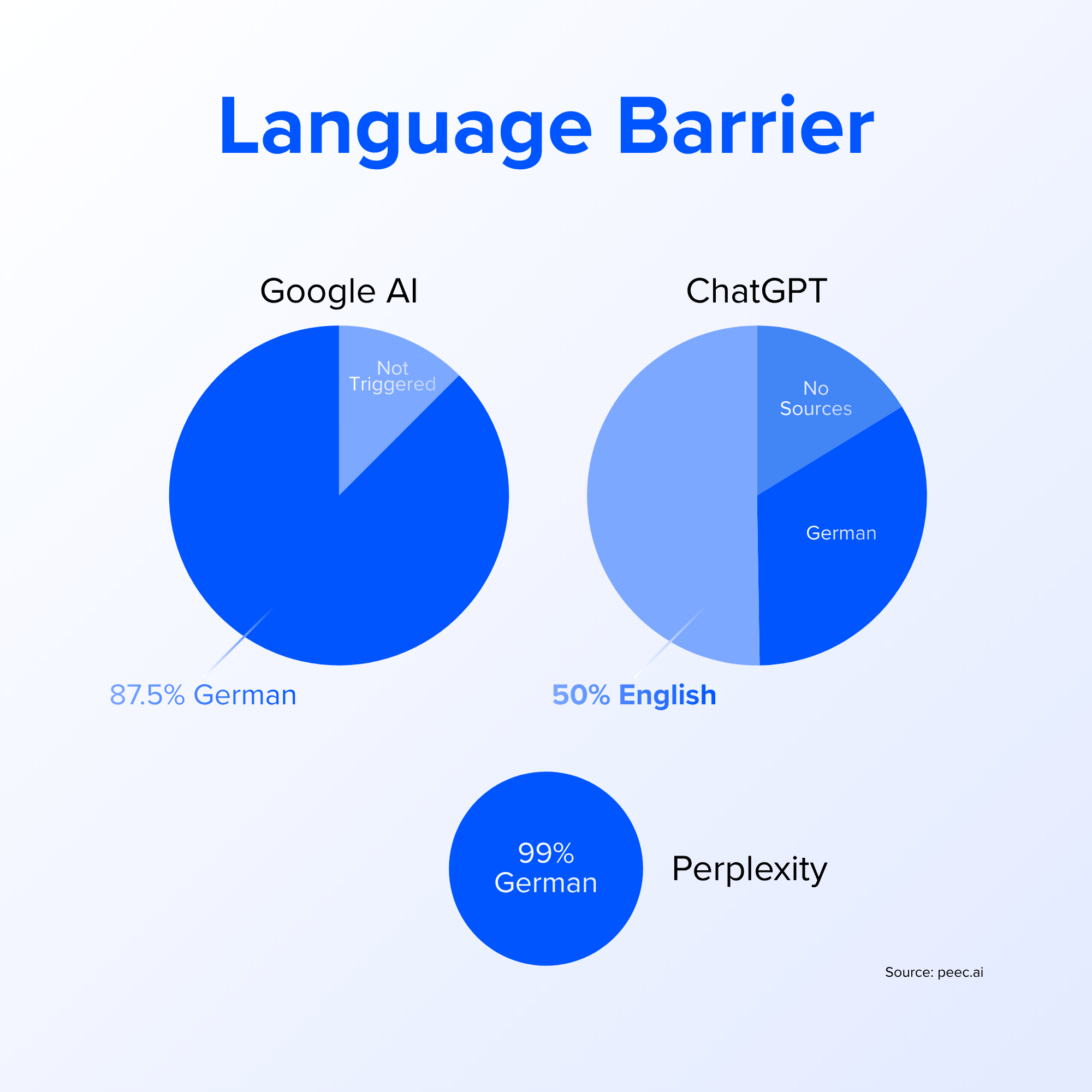
- Language Barrier: In 50% of cases, ChatGPT quotes English sources for German YMYL prompts, raising questions about accessibility. Especially for YMYL topics, it’s critical that users understand the source and aren’t lost in translation.
- Source Fragmentation: We’re not dealing with “AI search” as one unified thing. We’re dealing with different systems that only “agree” 5% of the time. AI search has splintered into varying systems.
- Quality Paradox: Many of the cited sources wouldn’t count as high-quality search results in my opinion, at least following the guidelines of the Search Quality Raters
 that SEOs have considered an important source of truth.
Methodology
For this analysis, I examined 24 YMYL (Your Money or Your Life ) queries in German, focusing specifically on mental health and relationship psychology topics. The dataset includes 282 unique domains cited across 600 total citations. I used Peec AI to systematically query three AI platforms with identical prompts: ChatGPT, Perplexity, and Google AI Overviews. The tool captures not only the AI-generated responses but also tracks which sources each platform cites, allowing for direct comparison of their citation patterns. All queries were submitted in German to examine how AI systems handle non-English YMYL content, a particularly important consideration given that health information should be accessible in users’ native languages.
The analysis was conducted at the domain level rather than individual URL level. This reflects how AI systems appear to evaluate source authority and provides more robust patterns.
The queries were selected based on my experience as an SEO consultant working with high-ranking organic content in the German YMYL space. Each query represents a search term with significant monthly volume and competitive ranking dynamics that I’ve observed through client work. The queries themselves lean toward relationship psychology and attachment theory rather than acute medical emergencies. This was intentional. These topics sit in an interesting middle ground within YMYL content.
The analysis focused on three dimensions. First, I tracked the language of cited sources to understand whether platforms serve English or German content for German-language queries. Second, I mapped which domains appeared across which platforms to quantify the degree of overlap or fragmentation in their source selection. Third, I manually assessed source quality by applying Google’s Search Quality Rater Guidelines, evaluating each cited domain for medical authority, editorial standards, and evidence-based content.
Language Barriers
While Perplexity and Google AI stayed almost exclusively within the German-speaking web ecosystem (96% German sources), ChatGPT exhibited a remarkable 50% English source rate for German-language YMYL queries. This reflects fundamental differences in how these AI systems conceptualize authority.
ChatGPT also tends to quote more high-quality sources. Comparatively, many of the English sources from ChatGPT are high-authority domains.
ChatGPT’s exclusive sources include:
- healthline.com: 5 citations
- health.clevelandclinic.org: 4 citations
- counseling.ufl.edu: 3 citations
- psychologytoday.com: 5 citations
None of these appear in Perplexity or Google AI results.
That means German speakers using ChatGPT get better medical authority but worse linguistic accessibility. They receive the best information in a language that creates barriers precisely when clarity matters most (YMYL).
This is more than a translation inconvenience. It’s a fundamental accessibility issue. Users seeking help during vulnerable moments must navigate difficult terminology in a foreign language. They likely lose critical context in the process, especially when dealing with nuanced health and psychology concepts that don’t translate cleanly.
Source Fragmentation
The language barrier is only part of a larger fragmentation problem. The data reveals something fundamental: 208 out of 282 unique domains appear exclusively on a single platform. This means roughly 70% of all sources are platform-exclusive (on a domain-level):
| Platform Combination | % of Total |
| ChatGPT only | 34.0% |
| Perplexity only | 23.8% |
| Google AI only | 16.0% |
| Perplexity + Google AI | 16.3% |
| ChatGPT + Google AI | 2.8% |
| ChatGPT + Perplexity | 1.8% |
| All three | 5.3% |
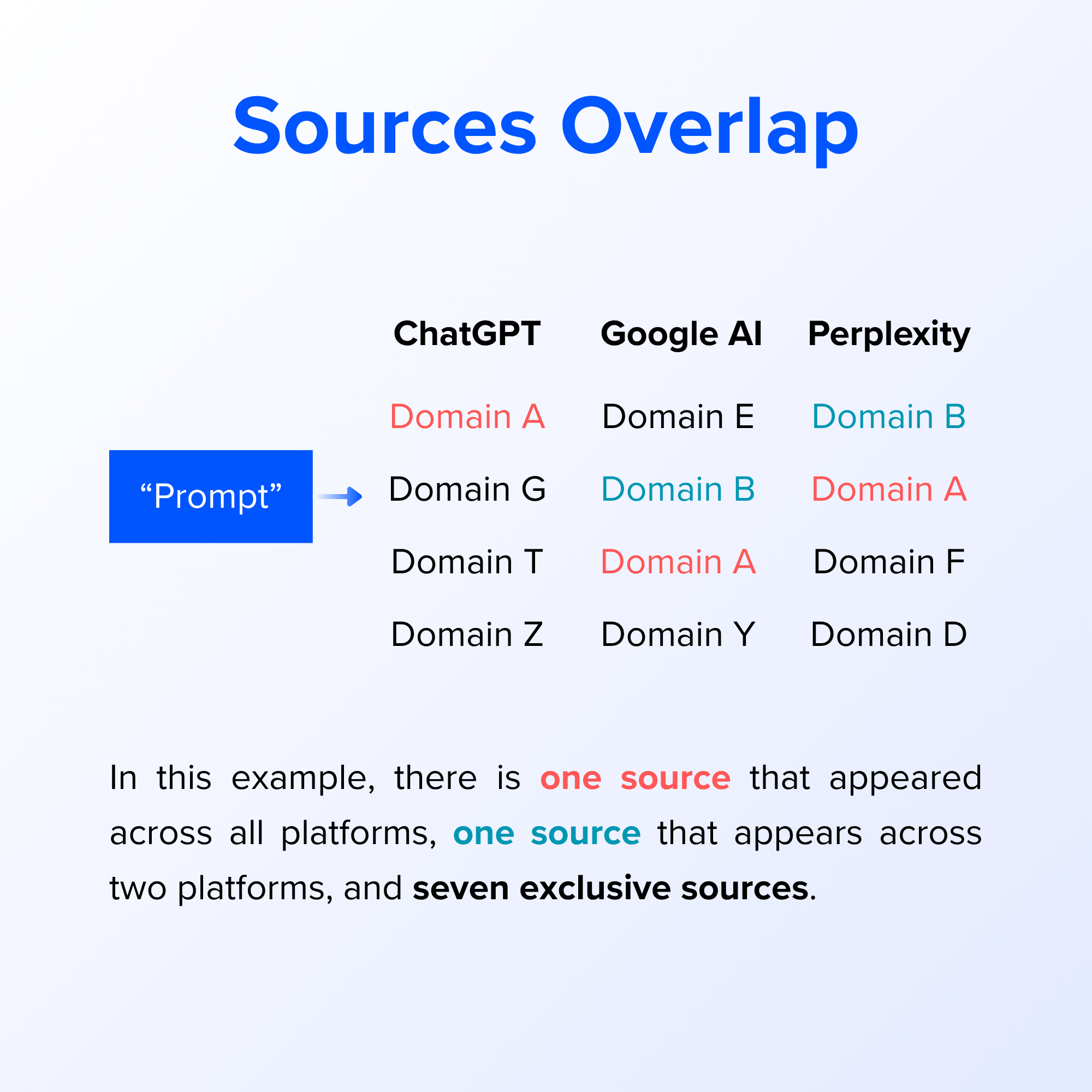
Only a few prompts (e.g., “symptome bei verlustangst”) have even one or two domains shared across all three systems. On average, each query had 15 to 20 domains, with roughly 70% unique to a single platform. ChatGPT tends to include 5–10 exclusive domains per prompt. Perplexity often overlaps more with Google AI.
Out of 24 prompts, only 4 had at least one domain that appeared across all three platforms.
To put this in perspective: a 2022 study showed an overlap of 31% between Bing and Google for the top search result. AI search has six times less consensus than traditional search engines.
This fragmentation creates both fascinating opportunities and serious risks. There’s a zero-overlap phenomenon going on. This suggests we’re not seeing variations of a single search logic, but rather three fundamentally different models of YMYL authority. This isn’t three variations of the same algorithm.
One explanation for this: Platforms use different query fan-out strategies. When you ask a question, AI systems don’t just search for your exact words. They break your query into multiple searches behind the scenes, exploring different angles and terminology.
The implications for SEO are significant. Optimizing for one AI system could actually reduce visibility in another. For example, listicles might work well for ChatGPT at the moment, but they might hurt your Perplexity rankings.
High fragmentation across sources makes it difficult to identify overlapping patterns or clear optimization opportunities. The underlying logic of ChatGPT, Perplexity, and Google AI differs sharply.

ChatGPT users are more exposed to American, clinically oriented perspectives, drawing from sources like the Cleveland Clinic and Psychology Today. Content rooted in DSM-5 classifications and cognitive-behavioral frameworks.
Perplexity users, by contrast, encounter German-language content dominated by YouTube videos and Reddit discussions, emphasizing community experiences over clinical guidance.
Google AI surfaces yet another ecosystem, German lifestyle blogs, and coaching sites that view mental health through the lens of wellness and self-improvement.
YouTube stands out as the rare cross-platform source, ranking as the second-most cited platform for both Perplexity (20 citations) and Google AI (22 citations). ChatGPT barely references video content. This highlights how Perplexity and Google have integrated multimodal content into their knowledge graphs.
Quality Paradox
Following Google’s Quality Rater Guidelines for YMYL content, I assessed the sources for authority, editorial standards, and evidence quality. The vast majority fail to meet the standards I’d expect for health information, with ChatGPT citing the most authoritative sources.
Even more revealing: not a single AI platform cited original research papers, despite extensive academic literature on these topics. This represents a missed opportunity. AI could bridge the gap between academic rigor and public understanding by summarizing research in digestible language while citing the original source. Instead, they cite lifestyle blogs and magazines that have already digested and potentially distorted the primary research.

Before AI search, it made sense not to show, for example, a scientific meta-review in the SERP for a query like “symptoms anxious attachment.” Many users wouldn’t have been able to understand the original source. But why wouldn’t AI summarize the body of research in a digestible way and then point to the scientific source?
Perhaps the YMYL prompts weren’t “YMYL enough,” leaning towards relationship topics rather than pure mental health emergencies. However, relationship psychology and attachment theory are still sensitive topics where source quality matters, even if they don’t carry the same risk as medical diagnoses or financial advice.
Implications
Not everything has changed for SEOs, especially not the basics, but the landscape is fragmenting and shifting focus to different areas. Here’s what matters now:
Platform-Specific Optimization Is Important
You need to understand which system you’re optimizing for. With 70% platform exclusivity, the differences matter more than the similarities. What works well on one platform might not translate to another. Listicles seem to perform better on ChatGPT than on Perplexity, for example.
This creates interesting strategic choices: optimize specifically for one platform, find approaches that work across multiple systems (like PR and external visibility on YouTube or Reddit), or develop platform-specific content variations.
The 5% overlap suggests these systems value different things, which opens up questions about what those differences actually are and how to navigate them.
Smaller Players Have an Opening
Smaller companies can gain visibility. Domains like chrisbloom.de or 7mind.de prove you don’t need to be a major publisher to gain AI visibility. Understanding platform-specific preferences and creating niche expert content matters more than traditional domain authority.
There’s a window of opportunity right now for smaller companies to establish themselves in both SEO and GEO. The fragmentation means the playing field is more open than it’s been in years. Be an expert in your niche and make that expertise visible through both owned content and earned visibility. Build topical authority by consistently demonstrating deep knowledge in your specific area, whether that’s relationship psychology, meditation techniques, or specialized coaching.
Invest in your brand and clearly communicate what you stand for. AI systems are increasingly looking for signals of genuine expertise and credentials.
External Platforms Are a Multiplier
Perplexity and Google AI surface German-language YouTube videos (20 citations) and Reddit discussions (6 citations), emphasizing community experiences. YouTube and Reddit offer the rare cross-platform visibility.
If you can’t maintain three optimization strategies, build presence on platforms where all three AI systems already look.
The Core Mission Hasn’t Changed
The most important pillar of the job description hasn’t changed: SEOs still help people to find the most relevant and reliable information for their intent. As AI search fragments into different systems, the need for skilled optimization across multiple platforms only increases.
We’re learning to optimize for new platforms in real-time, watching systems evolve as they emerge. This evolution is significant. The role of ChatGPT and similar platforms will likely grow more important over time. The systems will become more sophisticated, learning how to surface and reference the most helpful content and sources for users.
The fundamental mission hasn’t changed: people are looking for answers to challenges and problems online. What’s changing is where they look and how information reaches them. AI-driven platforms don’t rely on the paradigm of websites and blue links as much anymore. Sometimes they’re synthesized answers with citations. Sometimes they’re conversational responses that weave together multiple sources.
As the landscape fragments and evolves, the SEO professionals who adapt quickest, who understand multiple platforms, and who prioritize user value over gaming systems will thrive. We’re moving from “how do I rank” to “how do I become the authoritative answer my audience needs across multiple discovery paths.”